
- Homepage
- Author
- Anatole France (4)
- Auguste Maquet (4)
- Benoît Fourneyron (3)
- Beydts (louis) (4)
- Charles Wagner (3)
- Chateaubriand (5)
- Colette (4)
- Henri Barbusse (5)
- Jean-léon Gérôme (5)
- Julien DuprÉ (4)
- Louis Jouvet (4)
- Louise Read (6)
- Ludovic Halévy (4)
- Marcel Proust (5)
- Michel Chamillart (4)
- Paul Chabas (4)
- Paul Meurice (4)
- Roger Martin Du Gard (6)
- Sully Prudhomme (7)
- Violette Leduc (4)
- Other (4439)
- Era
- 18th Century (18)
- 1900 To 1960 (94)
- 1930s (4)
- 1960s (5)
- 1970s (8)
- 19th (6)
- 19th Century (102)
- 20th Century (25)
- Beautiful Era (13)
- Belle Epoque (55)
- First Empire (10)
- Nineteenth (20)
- Nineteenth Century (13)
- Post-war (23)
- Restoration (17)
- Revolution (5)
- Roaring Twenties (30)
- Second Empire (24)
- Second World War (7)
- World War Ii (9)
- Other (4040)
- Language
- Period
- 18th Century (12)
- 1900 To 1960 (157)
- 1960s (2)
- 19th (2)
- 19th Century (136)
- 20th Century (15)
- Belle Epoque (10)
- Belle Époque (2)
- First Empire (2)
- Nineteenth (24)
- Nineteenth Century (5)
- Post-war (5)
- Restoration (7)
- Revolution (3)
- Roaring Twenties (4)
- Second Empire (6)
- World War I (3)
- Xixth (6)
- Xixth Century (11)
- Other (4116)
- Subject
- Theme
Théophile Delcassé (1852-1923) Autographed letter signed to Camille Barrère, 1916
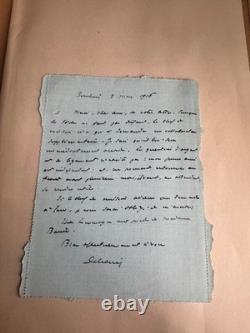
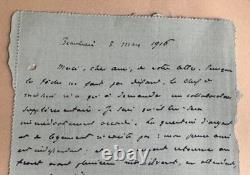
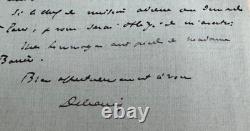

Autographed letter signed to Camille Barrère, Beaulieu, March 5, 1916. 1 page in-12° on blue laid paper with scalloped edges, printed letterhead of the Hôtel Métropole, Beaulieu-sur-Mer.
Postage stamp and postal marks from Beaulieu and Rome. A friendly and political letter addressed to the French ambassador in Rome, then a major figure in Italian diplomacy. Delcassé thanks him for his help in an administrative matter and mentions the difficulties in finding a collaborator. “Since the task is not lacking, the head of the mission only needs to request an additional collaborator. The question of money and housing does not exist; my young friend is independent.
” Your direct tone, imbued with esteem and cordiality, is set against the backdrop of World War I, when Franco-Italian cooperation was facilitated through Barrère, a key figure in bringing the two countries closer. Théophile Delcassé (1852 - 1923) was one of the great architects of French diplomacy during the Belle Époque. A journalist of modest origins who became a statesman, he embodies the cautious and skillful France of the pre-1914 era. A radical deputy from the Hautes-Pyrénées, he entered the Foreign Affairs early on.
His opposition to Germany during the Tangier crisis (1905) led to his downfall: Berlin demanded his resignation, a sign of his influence. In summary, Delcassé is the diplomat who prepared, long before 1914, the system of alliances that would isolate Germany and shape French foreign policy until the Great War.