
- Homepage
- Author
- Anatole France (4)
- Auguste Maquet (4)
- Benoît Fourneyron (3)
- Beydts (louis) (4)
- Charles Wagner (3)
- Chateaubriand (5)
- Colette (4)
- Henri Barbusse (5)
- Jean-léon Gérôme (5)
- Julien DuprÉ (4)
- Louis Jouvet (4)
- Louise Read (6)
- Ludovic Halévy (4)
- Marcel Proust (5)
- Michel Chamillart (4)
- Paul Chabas (4)
- Paul Meurice (4)
- Roger Martin Du Gard (6)
- Sully Prudhomme (7)
- Violette Leduc (4)
- Other (4440)
- Era
- 18th Century (18)
- 1900 To 1960 (94)
- 1930s (4)
- 1960s (5)
- 1970s (8)
- 19th (6)
- 19th Century (102)
- 20th Century (25)
- Beautiful Era (13)
- Belle Epoque (55)
- First Empire (10)
- Nineteenth (20)
- Nineteenth Century (13)
- Post-war (23)
- Restoration (17)
- Revolution (5)
- Roaring Twenties (30)
- Second Empire (24)
- Second World War (7)
- World War Ii (9)
- Other (4041)
- Language
- Period
- 18th Century (12)
- 1900 To 1960 (157)
- 1960s (2)
- 19th (2)
- 19th Century (136)
- 20th Century (15)
- Belle Epoque (10)
- Belle Époque (2)
- First Empire (2)
- Nineteenth (24)
- Nineteenth Century (5)
- Post-war (5)
- Restoration (7)
- Revolution (3)
- Roaring Twenties (4)
- Second Empire (6)
- World War I (3)
- Xixth (6)
- Xixth Century (11)
- Other (4117)
- Subject
- Theme
Romain Gary Signed Autographed Letter The Roots of Heaven Gallimard Julliard
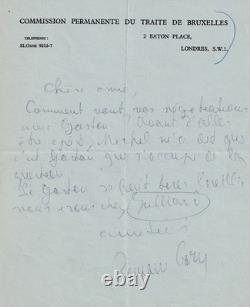
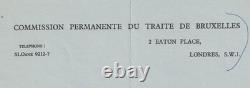
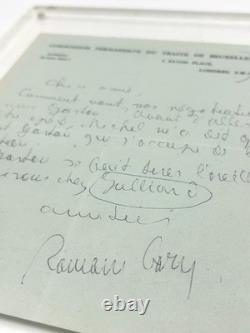
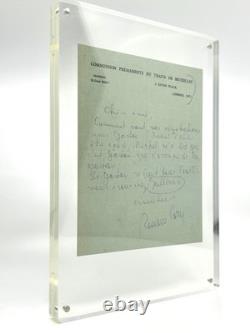



[1955] On letterhead from the Permanent Commission of the Brussels Treaty, in London. Size: 20 x 16 cm / With included magnetic plexiglass frame: 21 x 30 cm. An interesting letter beautifully signed by Romain Gary, eager to move forward with the negotiation for the publication of The Roots of Heaven. Gaston Gallimard was not particularly eager to respond to the author at that time, as his publishing house was still burdened with unsold copies of his last novel, The Colors of the Day, published by Gallimard in 1952. This letter is informative as it shows that the possibility of publication with Julliard was genuinely considered.
In this sense, there is a letter from the same Odette Arnaud to Romain Gary, dated July 16, 1954, strongly encouraging this direction. However, there is one question I would like to ask you immediately, as it will guide all our work. The question is this: Would you consider leaving Gallimard even though it truly is the best intellectual environment for you and also despite Gallimard's deep friendship for you? At Gallimard, we encounter a vast routine organization. There is no need to mention the advantages of going elsewhere, as you can guess them.
This elsewhere could hardly be anyone other than Julliard. Dear friend, how are your negotiations with Gaston going? Before going for surgery, Michel told me that it is Gaston who is handling the matter.
If Gaston drags his feet, we will go to Julliard. In 1954, Gary is not promoted to first-class advisor until the end of his mission in New York. Upon his return, he is appointed embassy secretary in London.
On the letterhead: The Brussels Treaty provides for the organization of military, economic, social, and cultural cooperation among its member states, as well as a mutual defense clause. It is signed for 50 years between France, the United Kingdom, Belgium, the Netherlands, and Luxembourg. It gives rise to a Western Union that foreshadows the Western European Union, a solely defensive alliance. Gaston and Michel Gallimard, the nephew of Gaston Gallimard, whom the latter considered as his spiritual son and who tragically passed away in 1960 in a car accident that also claimed the life of Albert Camus.