
- Homepage
- Author
- Anatole France (3)
- Auguste Maquet (4)
- Beydts (louis) (4)
- Charles De Gaulle (3)
- Chateaubriand (5)
- Colette (4)
- Henri Barbusse (5)
- Jean-léon Gérôme (5)
- Julien DuprÉ (4)
- Louis Jouvet (4)
- Louise Read (6)
- Ludovic Halévy (4)
- Marcel Proust (5)
- Michel Chamillart (4)
- Paul Chabas (4)
- Paul Meurice (4)
- Roger Martin Du Gard (6)
- Salomon Reinach (3)
- Sully Prudhomme (7)
- Violette Leduc (4)
- Other (4408)
- Era
- 18th Century (18)
- 1900 To 1960 (94)
- 1960s (5)
- 1970s (8)
- 19th (6)
- 19th Century (100)
- 20th Century (23)
- Beautiful Era (13)
- Belle Epoque (55)
- First Empire (10)
- First World War (4)
- Nineteenth (20)
- Nineteenth Century (13)
- Post-war (23)
- Restoration (17)
- Revolution (5)
- Roaring Twenties (30)
- Second Empire (24)
- Second World War (7)
- World War Ii (9)
- Other (4012)
- Language
- Period
- 18th Century (12)
- 1900 To 1960 (156)
- 1960s (2)
- 19th (2)
- 19th Century (129)
- 20th Century (15)
- Belle Epoque (10)
- Belle Époque (2)
- First Empire (2)
- Nineteenth (24)
- Nineteenth Century (5)
- Post-war (5)
- Restoration (7)
- Revolution (3)
- Roaring Twenties (4)
- Second Empire (5)
- World War I (3)
- Xixth (6)
- Xixth Century (11)
- Other (4093)
- Subject
- Type
Music by Eugène BIGOT (1888-1965) composer 8 signed autographs
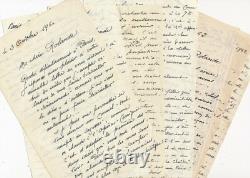
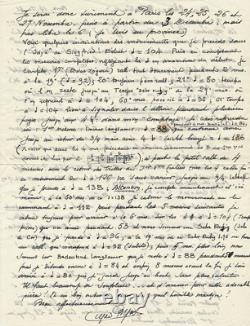
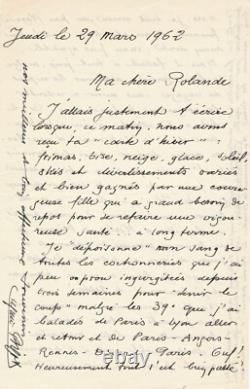
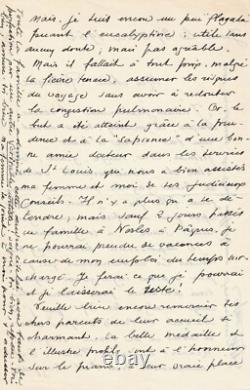


Addressed to a young woman, Rolande Favret, daughter of friends, wishing to become a conductor. 17 pages in-8 or in-4. October 3, 1960: he agrees to have her work: “work carefully on Beethoven's 1st Symphony or otherwise on the 4th (in B flat) that I will have my students work on first this winter.” He wishes to prepare her for the Besançon competition and that of the Conservatory for the year 1961. July 1, 1961: she has an “unheard-of” chance to rehearse with an orchestra and a quartet.
He gives her advice on her program, the Idyll of Siegfried, “don't get involved in Bruckner, it's perilous,” “Saint-Saëns' 1st symphony (in E flat) is rarely played, I don't see why; The Unfinished by Bovodine neither (with its amusing 5/8).” “For the Beautiful Blue Danube, don't worry about the version for choir and special reprises” (he specifies later). He points out the rehearsal measures for the 1st movement of Brahms. September 21, 1961: Rolande Favret is worried... Eugène Bigot reassures her: “patience, stubbornness, and...
Kindness are the three cardinal virtues of the conductor. Then, firmness, the gift of sympathy, composure, even temperament, insight, appreciation of difficulties, progress, failures, the impossibilities of overcoming, the organization of work... November 14, 1961: he gives her addresses and recommends her for purchasing instruments and then provides her with very detailed indications on movements of the Idyll of Siegfried. May 5, 1962: he gives his schedule between rehearsals and recordings, and provides some reading instructions for orchestral scores by Liszt and Strauss. July 21, 1962: her application has been rejected for the Besançon conducting competition. Eugène Bigot is surprised and reassures her: “And then, there is not only Besançon, which is one of the most arduous competitions, if not the most difficult and serious of all.” He is affected by the death of his friend Edouardo Toldra from Barcelona, “exhausted by the world premiere at the Liceo of Manuel de Falla's Atlantide. It is a great loss for his friends and for music.