
- Homepage
- Author
- Anatole France (4)
- Auguste Maquet (4)
- Benoît Fourneyron (3)
- Beydts (louis) (4)
- Charles Wagner (3)
- Chateaubriand (5)
- Colette (4)
- Henri Barbusse (5)
- Jean-léon Gérôme (5)
- Julien DuprÉ (4)
- Louis Jouvet (4)
- Louise Read (6)
- Ludovic Halévy (4)
- Marcel Proust (5)
- Michel Chamillart (4)
- Paul Chabas (4)
- Paul Meurice (4)
- Roger Martin Du Gard (6)
- Sully Prudhomme (7)
- Violette Leduc (4)
- Other (4440)
- Era
- 18th Century (18)
- 1900 To 1960 (94)
- 1930s (4)
- 1960s (5)
- 1970s (8)
- 19th (6)
- 19th Century (102)
- 20th Century (25)
- Beautiful Era (13)
- Belle Epoque (55)
- First Empire (10)
- Nineteenth (20)
- Nineteenth Century (13)
- Post-war (23)
- Restoration (17)
- Revolution (5)
- Roaring Twenties (30)
- Second Empire (24)
- Second World War (7)
- World War Ii (9)
- Other (4041)
- Language
- Period
- 18th Century (12)
- 1900 To 1960 (157)
- 1960s (2)
- 19th (2)
- 19th Century (136)
- 20th Century (15)
- Belle Epoque (10)
- Belle Époque (2)
- First Empire (2)
- Nineteenth (24)
- Nineteenth Century (5)
- Post-war (5)
- Restoration (7)
- Revolution (3)
- Roaring Twenties (4)
- Second Empire (6)
- World War I (3)
- Xixth (6)
- Xixth Century (11)
- Other (4117)
- Subject
- Theme
Louis-Ferdinand CÉLINE Autographed Letter Signed Hugo Siménon Descaves
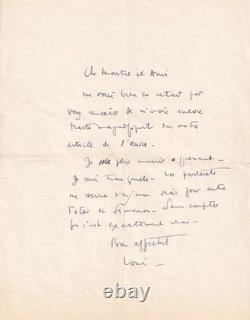
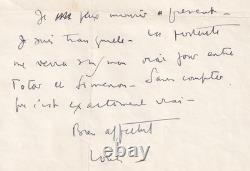

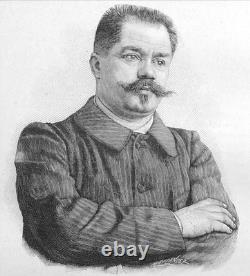

Unpublished letter to the correspondence of the Pléiade. Posterity will see me in my true light between Totor and Simenon." Louis-Ferdinand Céline thanks his friend Lucien Descaves for his flattering article on December 7, 1933, in L'Ouvre about "Journey to the End of the Night," a year after his failure to win the Prix Goncourt. Lucien Descaves, a member of the Goncourt jury, was one of the key figures in the success of "Journey to the End of the Night," creating controversy by storming out when Céline was not awarded.
In his article, Lucien Descaves compares Céline to Victor Hugo, Georges Simenon, and Arthur Schopenhauer. I am quite late in thanking you for treating me magnificently once again in your article in L'Ouvre. Not to mention that it is exactly true. Below we transcribe the beginning and the end of the very interesting article by Lucien Descaves in L'Ouvre on Thursday, December 7, 1933."This is not the year of the first performance of Cromwell nor the year of the battle of Hernani. But a year later, on the anniversary of the awarding of the Goncourt 1933, I tell myself that this literary event still holds a certain importance.
On December 6, 1932, the Goncourt Academy did not award its Prize to Louis-Ferdinand Céline, but there are defeats that are at least as glorious as victories, and the book that did not receive the Goncourt Prize has surpassed, one might say, the crowned work in resonance. And that is enough for me not to feel I am betraying Edmond de Goncourt's trust by considering the books of Louis-Ferdinand Céline and Georges Simenon as "new and bold attempts of thought and form" (these are the terms of his testament). Both love life, and it is not by the way they translate it that they would fall short in our eyes - on the contrary.
They shake the cult we had for artistic writing, but they do not propose to write poorly for that reason: they only show the intention of writing differently. The vulgarities that are reproached to Céline are found in old authors, just as his pessimism is in Schopenhauer, whom we loved in the time of naturalism. It is not when the dust of the old world is shaken, as it is now by a tremor of everything, that we should be surprised by the oscillations of thought and expression.
" Below, Lucien Descaves engraving by Charles Maylander, 1908.