
- Homepage
- Author
- Anatole France (4)
- Auguste Maquet (4)
- Benoît Fourneyron (3)
- Beydts (louis) (4)
- Charles Wagner (3)
- Chateaubriand (5)
- Colette (4)
- Henri Barbusse (5)
- Jean-léon Gérôme (5)
- Julien DuprÉ (4)
- Louis Jouvet (4)
- Louise Read (6)
- Ludovic Halévy (4)
- Marcel Proust (5)
- Michel Chamillart (4)
- Paul Chabas (4)
- Paul Meurice (4)
- Roger Martin Du Gard (6)
- Sully Prudhomme (7)
- Violette Leduc (4)
- Other (4439)
- Era
- 18th Century (18)
- 1900 To 1960 (94)
- 1930s (4)
- 1960s (5)
- 1970s (8)
- 19th (6)
- 19th Century (102)
- 20th Century (25)
- Beautiful Era (13)
- Belle Epoque (55)
- First Empire (10)
- Nineteenth (20)
- Nineteenth Century (13)
- Post-war (23)
- Restoration (17)
- Revolution (5)
- Roaring Twenties (30)
- Second Empire (24)
- Second World War (7)
- World War Ii (9)
- Other (4040)
- Language
- Period
- 18th Century (12)
- 1900 To 1960 (157)
- 1960s (2)
- 19th (2)
- 19th Century (136)
- 20th Century (15)
- Belle Epoque (10)
- Belle Époque (2)
- First Empire (2)
- Nineteenth (24)
- Nineteenth Century (5)
- Post-war (5)
- Restoration (7)
- Revolution (3)
- Roaring Twenties (4)
- Second Empire (6)
- World War I (3)
- Xixth (6)
- Xixth Century (11)
- Other (4116)
- Subject
- Theme
Handwritten autograph letter from General Alain de Boissieu, De Gaulle, WWII, Companion
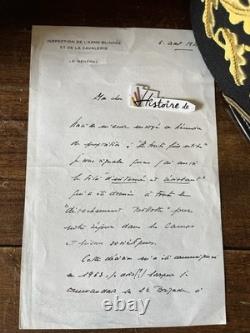
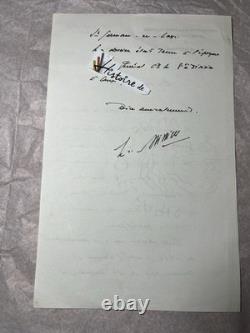
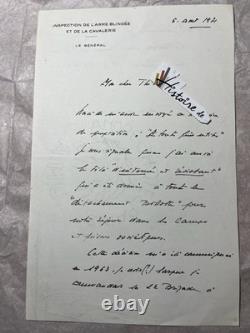
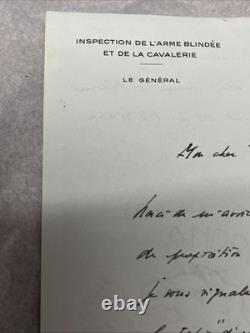
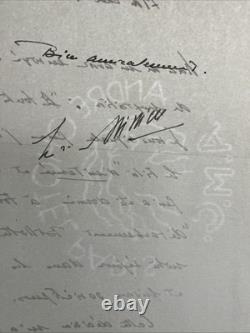

HANDWRITTEN AUTOGRAPH LETTER – GENERAL ALAIN DE BOISSIEU. Exceptional historical piece – authentic original document. Long handwritten letter entirely written and signed by General Alain de Boissieu, on official letterhead paper of the Inspection of the Armored Arm and Cavalry, dated April 6, 1971. Black ink, legible handwriting, paper in good condition. A young cavalry second lieutenant, surrounded by the Germans, orders a saber charge at the head of his 35 men, one of the last cavalry charges in French history. His name is Alain de Boissieu.
Taken prisoner, he escapes in March 1941 from Oflag II D in Pomerania and heads east. But Stalin is not yet at war, and the Soviets intern him in turn. From Nazi camps to Stalinist camps, without even having fought.
In a camp south of Moscow, he meets 185 French soldiers who had escaped from Germany, organized under the authority of Captain Pierre Billotte. Together they wait, resist, and organize themselves in what de Boissieu would call the “Billotte Detachment.” In September 1941, the Soviet Union’s entry into the war changes everything. Via Arkhangelsk and Spitsbergen, the 185 finally reach London and General de Gaulle.
De Boissieu would become his son-in-law. Billotte, his chief of staff. Thirty years later, at the height of his career, General de Boissieu takes up his pen on the letterhead of the Inspection of the Armored Arm and Cavalry — the branch of his heroic youth — to write to Thibault Billotte this unpublished, long, and personal handwritten letter, evoking the camps, the Soviet prisons, and the brotherhood forged in adversity. WHO WAS ALAIN DE BOISSIEU? Army General, Companion of the Liberation.Son-in-law of General de Gaulle (husband of Élisabeth de Gaulle). Present in the car during the Petit-Clamart assassination attempt against de Gaulle in 1962.
Died in 2006, buried in Colombey-les-Deux-Églises. General, Companion of the Liberation. Special chief of staff to General de Gaulle. Tank ace — destroyed 13 German tanks in a single day at Stonne in May 1940.
Commander of the group of 185 Frenchmen interned in the USSR in 1941.