
- Homepage
- Author
- Anatole France (4)
- Auguste Maquet (4)
- Benoît Fourneyron (3)
- Beydts (louis) (4)
- Charles Wagner (3)
- Chateaubriand (5)
- Colette (4)
- Henri Barbusse (5)
- Jean-léon Gérôme (5)
- Julien DuprÉ (4)
- Louis Jouvet (4)
- Louise Read (6)
- Ludovic Halévy (4)
- Marcel Proust (5)
- Michel Chamillart (4)
- Paul Chabas (4)
- Paul Meurice (4)
- Roger Martin Du Gard (6)
- Sully Prudhomme (7)
- Violette Leduc (4)
- Other (4439)
- Era
- 18th Century (18)
- 1900 To 1960 (94)
- 1930s (4)
- 1960s (5)
- 1970s (8)
- 19th (6)
- 19th Century (102)
- 20th Century (25)
- Beautiful Era (13)
- Belle Epoque (55)
- First Empire (10)
- Nineteenth (20)
- Nineteenth Century (13)
- Post-war (23)
- Restoration (17)
- Revolution (5)
- Roaring Twenties (30)
- Second Empire (24)
- Second World War (7)
- World War Ii (9)
- Other (4040)
- Language
- Period
- 18th Century (12)
- 1900 To 1960 (157)
- 1960s (2)
- 19th (2)
- 19th Century (136)
- 20th Century (15)
- Belle Epoque (10)
- Belle Époque (2)
- First Empire (2)
- Nineteenth (24)
- Nineteenth Century (5)
- Post-war (5)
- Restoration (7)
- Revolution (3)
- Roaring Twenties (4)
- Second Empire (6)
- World War I (3)
- Xixth (6)
- Xixth Century (11)
- Other (4116)
- Subject
- Theme
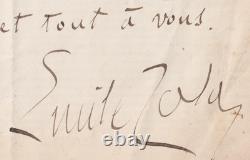
Émile Zola judges his second novel, autograph letter signed, 1889
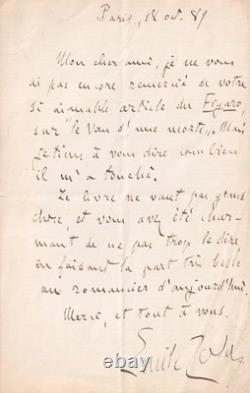

Émile Zola touched by the leniency shown toward his second, little-known novel, “Le Vœu d’une morte.” The book is not worth much, and you were very charming not to say that too bluntly... One in-8 page on a double leaf. Size: 20.5 x 13.3 cm.
Interesting letter about Zola’s view of his second novel, Le Vœu d’une morte, originally published in 1866 when he was 26 years old (see below).
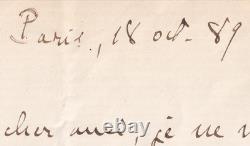
In this same month of October 1889, Zola’s publisher, Georges Charpentier, decided to republish Zola’s early works. The writer knew perfectly well that this text was weak compared with his masterpieces, but he found the comparison interesting. He warmly thanked Galdemar for having given “very generous space to the novelist of today” in his article in Le Figaro, published the day before on October 16, 1889.
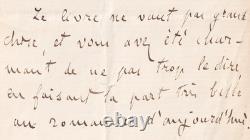
A copy of the Figaro article is included with the letter.My dear friend, I have not yet thanked you for your very kind article in Le Figaro about “Le Vœu d’une morte.” I want to tell you how much it touched me. The book is not worth much, and you were very charming not to say so too much, while giving very generous space to the novelist of today. Thank you, and wholly yours.
Le Vœu d’une morte (which follows La Confession de Claude, Zola’s first novel, published in 1865) first appeared in L’Événement on the 11th of... Then in book form with Achille Faure. For the 1889 edition at Charpentier, Zola rewrote a large part of his text and prefaced it with a note: “I have decided to release it to the public, not for its merit, certainly, but for the interesting comparison that curious readers of literature may one day be tempted to make between these first pages and those I wrote later.”
Summary: Blanche de Rionne, a young aristocrat in an unhappy marriage, takes charge of the education of Daniel, a boy who has miraculously escaped a fire. On her deathbed, she entrusts him with the moral guardianship of her daughter Jeanne, who is six years old. When Jeanne leaves the convent at 18, Daniel plays the “silent role of tutor,” following her everywhere, dressed in black.
But he cannot prevent her from making a bad marriage, and then from falling in love with his best friend, Georges, to whom, in turn, as he is about to die, he entrusts her.
Zola plays along with the conventions of the popular novel: black-and-white characters, dramatic plot twists, pathos, good sentiments, and disregard for plausibility. It is meant to move the inhabitants of garrets and cottages.
Compared with La Confession de Claude, the improvement is noticeable. It is a piece of commercial literature; however, the background reveals a fierce social vision that would later be developed in La Curée.
[Possibility of framing with mat and anti-UV, anti-glare glass, 250E].
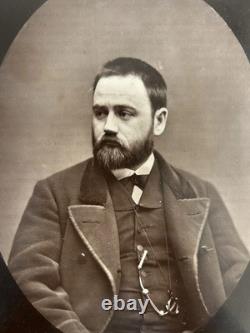
Below: famous portrait of the young Émile Zola by Étienne Carjat, from the time of Le Vœu d’une morte.