
- Homepage
- Author
- Anatole France (4)
- Auguste Maquet (4)
- Benoît Fourneyron (3)
- Beydts (louis) (4)
- Charles Wagner (3)
- Chateaubriand (5)
- Colette (4)
- Henri Barbusse (5)
- Jean-léon Gérôme (5)
- Julien DuprÉ (4)
- Louis Jouvet (4)
- Louise Read (6)
- Ludovic Halévy (4)
- Marcel Proust (5)
- Michel Chamillart (4)
- Paul Chabas (4)
- Paul Meurice (4)
- Roger Martin Du Gard (6)
- Sully Prudhomme (7)
- Violette Leduc (4)
- Other (4440)
- Era
- 18th Century (18)
- 1900 To 1960 (94)
- 1930s (4)
- 1960s (5)
- 1970s (8)
- 19th (6)
- 19th Century (102)
- 20th Century (25)
- Beautiful Era (13)
- Belle Epoque (55)
- First Empire (10)
- Nineteenth (20)
- Nineteenth Century (13)
- Post-war (23)
- Restoration (17)
- Revolution (5)
- Roaring Twenties (30)
- Second Empire (24)
- Second World War (7)
- World War Ii (9)
- Other (4041)
- Language
- Period
- 18th Century (12)
- 1900 To 1960 (157)
- 1960s (2)
- 19th (2)
- 19th Century (136)
- 20th Century (15)
- Belle Epoque (10)
- Belle Époque (2)
- First Empire (2)
- Nineteenth (24)
- Nineteenth Century (5)
- Post-war (5)
- Restoration (7)
- Revolution (3)
- Roaring Twenties (4)
- Second Empire (6)
- World War I (3)
- Xixth (6)
- Xixth Century (11)
- Other (4117)
- Subject
- Theme
DREYFUS AFFAIR Emile ZOLA / Signed autograph letter / Exile / Mirbeau / 1898
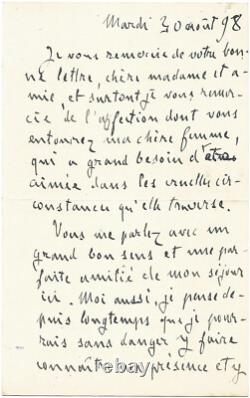
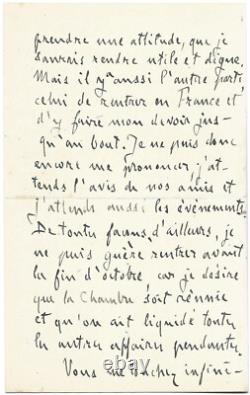
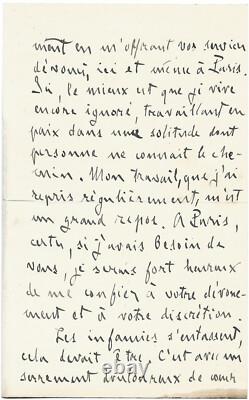
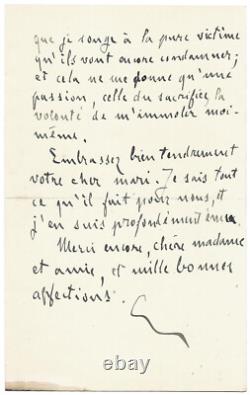

Autographed signed letter (initials) to Alice Mirbeau S. [Addlestone], Tuesday, August 30, [18]98, 4 pages. Central fold expertly reinforced, slight foxing, light stain on the lower margin of the second sheet without affecting the text. A letter of exile reflecting the unwavering commitment of the writer to the Dreyfus case.
"I thank you for your kind letter, dear madam and friend, and above all I thank you for the affection you surround my dear wife with, who greatly needs to be loved in the cruel circumstances she is facing. You speak to me with great common sense and perfect friendship about my stay here. I too have long thought that I could safely make my presence known there and take an attitude that I would know how to make useful and worthy. But there is also the other side, that of returning to France and doing my duty to the end. I cannot therefore yet pronounce, I await the advice of our friends and I also await the events.
In any case, I cannot really return before the end of October, as I want the chamber to be assembled and all other pending matters to be settled. You touch me infinitely by offering your devoted services, here and even in Paris. Here, the best thing is that I live still unknown, working in peace in a solitude that no one knows the way to. My work, which I have resumed regularly, is a great rest for me. In Paris, certainly, if I needed you, I would be very happy to trust in your devotion and discretion.Infamies are piling up, it had to be. It is with a painful tightening of the heart that I think of the pure victim. They are going to condemn again; and this gives me only one passion, that of sacrifice, the will to sacrifice myself. Embrace your dear husband very tenderly for me. I know all that he does for us, and I am deeply moved by it.
Thank you again, dear madam and friend, and a thousand good affections. Condemned definitively on July 18, 1898, by the Versailles court, Zola leaves France to join England. His open letter "J'accuse.!" published in L'Aurore on January 13, 1898, earns the writer a fine of 3,000 francs and 1 year in prison. Fully committed to the defense of Captain Dreyfus, Zola is forced into exile by Clemenceau and Labori and, at the same time, into silence.
Kept away from the Parisian furnace rife with all the passions surrounding the case, Zola sometimes reveals from England, as in this letter, a sense of frustration at no longer being at the center of the chessboard. Among the support he receives from his loved ones, the writer can count on that of Octave Mirbeau, an early supporter of Dreyfus. The latter, whose role has long been underestimated, was one of the most influential defenders of Captain Dreyfus and Zola. After publicly taking a stand for the first time in an article in the Journal on November 28, 1897 (two days after Zola's first article), it was Mirbeau who, in July 1898, paid the full fine to which Zola was condemned. Two weeks after Zola's condemnation, he writes in L'Aurore on August 2, 1898: "Are not professors, philosophers, scientists, writers, artists, all those in whom the truth resides, from all parts of France, going to finally liberate their souls from the awful weight that oppresses them?
Faced with these daily challenges to their genius, their humanity, their sense of justice, their courage, will they not finally understand that they have a great duty? That of defending the heritage of ideas, science, glorious discoveries, beauty, with which they have enriched the country, of which they are the guardians." We know of the letter of support that Alice Mirbeau, committed to her husband, addressed to Zola on August 24, to which our letter is a response: "Despite the pain I feel knowing how much you suffer from your isolation, I persist in believing that you must find the strength to wait, and that at all costs you must not hasten the end. Certainly, prison, where all those who love you could come to embrace you, would be sweeter for you and for your friends, but you must not abandon everything, especially now that there is a new victim about to be so harshly struck.] I am very happy that you have resumed your work, it will console you a little, for you must persist [...] If I can bring you any pleasure, soften your captivity a little by doing anything that would please you, use me, I beg you, I put my tenderness at your service and I will be happy to work to please you." At the very moment he writes this letter, Zola does not yet know it, but the case is about to turn on August 30. After completing the Dreyfus dossier with a piece he fabricated himself, Commander Henry confesses after his forgery is discovered by Captain Cuignet, military attaché to Minister Cavaignac. Immediately taken into custody at Mont Valérien, Henry commits suicide the next day in his cell, his throat slashed with a razor. Maurice and Denise Leblond, Bernouard, 1929, vol.