
- Homepage
- Author
- Anatole France (3)
- Auguste Maquet (4)
- Beydts (louis) (4)
- Charles De Gaulle (3)
- Chateaubriand (5)
- Colette (4)
- Henri Barbusse (5)
- Jean-léon Gérôme (5)
- Julien DuprÉ (4)
- Louis Jouvet (4)
- Louise Read (6)
- Ludovic Halévy (4)
- Marcel Proust (5)
- Michel Chamillart (4)
- Paul Chabas (4)
- Paul Meurice (4)
- Roger Martin Du Gard (6)
- Salomon Reinach (3)
- Sully Prudhomme (7)
- Violette Leduc (4)
- Other (4410)
- Era
- 18th Century (18)
- 1900 To 1960 (94)
- 1960s (5)
- 1970s (8)
- 19th (6)
- 19th Century (100)
- 20th Century (23)
- Beautiful Era (13)
- Belle Epoque (55)
- First Empire (10)
- First World War (4)
- Nineteenth (20)
- Nineteenth Century (13)
- Post-war (23)
- Restoration (17)
- Revolution (5)
- Roaring Twenties (30)
- Second Empire (24)
- Second World War (7)
- World War Ii (9)
- Other (4014)
- Language
- Period
- 18th Century (12)
- 1900 To 1960 (156)
- 1960s (2)
- 19th (2)
- 19th Century (129)
- 20th Century (15)
- Belle Epoque (10)
- Belle Époque (2)
- First Empire (2)
- Nineteenth (24)
- Nineteenth Century (5)
- Post-war (5)
- Restoration (7)
- Revolution (3)
- Roaring Twenties (4)
- Second Empire (5)
- World War I (3)
- Xixth (6)
- Xixth Century (11)
- Other (4095)
- Subject
- Type
DOMINIQUE AURY Thierry MAULNIER/ x2 Signed Autograph Letters / Love / 1936
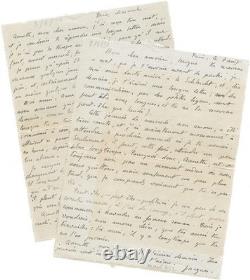
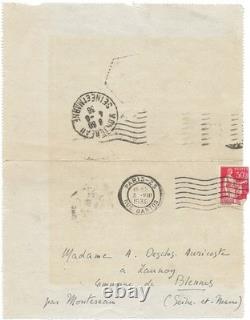
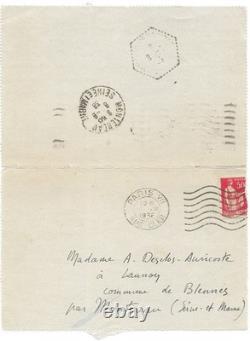
Two signed autograph letters addressed to Dominique Aury in Paris, dated August 3 and 7 [1936], totaling 2 pages. Autograph addresses, each stamped and postmarked. Two letters filled with affection addressed to his lover Dominique Aury, whose presence he misses deeply." [August 3, 1936] "Annette, my dear love, I received your note, and I would like to write you a long letter: but I don't have the time today, because I have to catch up on a bunch of overdue articles before Wednesday. I think that after coming to see you, I will go on vacation for a few days [...] and certainly, on August 19, I will be able to meet you for at least a few hours.
I too, Annette, felt that when we parted, you were leaving until the next day, like the other days; and it was only when you turned the corner of the street that I began to understand that five long days would pass without seeing you again: and hour by hour since then, it seems to me that I bear your absence less and less [...] Annette, my love, I will be at the meeting place on Wednesday, at the agreed time, and I will see you, I love you." [1936] "My dear love, when you receive this note, I will probably have arrived in Schlucht [the Schlucht pass in the Vosges mountains], and I will write you a long letter starting tomorrow.
] This Wednesday has been very short, my love, and I have now begun to look forward to the next Wednesday when I will see you. However, this time, we have to wait a little longer. Why, Annette, is it always not at the very moment we part, but only a little later, that I truly understand that you have left. Perhaps, -perhaps- I will take advantage of these short vacations, if I have the courage, if it rains, to start working on the famous novel¹. But I would like, my beloved, for you to work too: you too, you promised me a long time ago. Annette, my love, I will write to you tomorrow. Dominique Aury, whose real name is Anne Cécile Desclos, met Thierry Maulnier - the pseudonym of Jacques Talagrand - in 1933 through a mutual friend. Their secret relationship lasted eight years, during which Aury found the strength to divorce a violent husband, an experience she would partially draw upon to write, after World War II, Histoire d'Ô. Starting in 1937, Maulnier, an extreme right ideologue who had been aligned with Maurrassian theories since his years at the Louis le Grand high school alongside Brasillach, founded the weekly L'Insurgé to oppose the Popular Front. He regularly published articles in the arts section that his "Annette" signed, inspired by the name of her mother Louise Auricoste, using the androgynous pseudonym of Dominique Aury, without the editorial board itself discovering the author’s identity or even gender for a long time.1- Maulnier would not publish a novel. Alongside his work as a journalist, he wrote an ideological essay, Au-delà du nationalisme, published in 1937, and then a literary study, Introduction à la poésie française (prefaced by his lover Dominique Aury), published in 1939.