
- Homepage
- Author
- Anatole France (4)
- Auguste Maquet (4)
- Benoît Fourneyron (3)
- Beydts (louis) (4)
- Charles Wagner (3)
- Chateaubriand (5)
- Colette (4)
- Henri Barbusse (5)
- Jean-léon Gérôme (5)
- Julien DuprÉ (4)
- Louis Jouvet (4)
- Louise Read (6)
- Ludovic Halévy (4)
- Marcel Proust (5)
- Michel Chamillart (4)
- Paul Chabas (4)
- Paul Meurice (4)
- Roger Martin Du Gard (6)
- Sully Prudhomme (7)
- Violette Leduc (4)
- Other (4439)
- Era
- 18th Century (18)
- 1900 To 1960 (94)
- 1930s (4)
- 1960s (5)
- 1970s (8)
- 19th (6)
- 19th Century (102)
- 20th Century (25)
- Beautiful Era (13)
- Belle Epoque (55)
- First Empire (10)
- Nineteenth (20)
- Nineteenth Century (13)
- Post-war (23)
- Restoration (17)
- Revolution (5)
- Roaring Twenties (30)
- Second Empire (24)
- Second World War (7)
- World War Ii (9)
- Other (4040)
- Language
- Period
- 18th Century (12)
- 1900 To 1960 (157)
- 1960s (2)
- 19th (2)
- 19th Century (136)
- 20th Century (15)
- Belle Epoque (10)
- Belle Époque (2)
- First Empire (2)
- Nineteenth (24)
- Nineteenth Century (5)
- Post-war (5)
- Restoration (7)
- Revolution (3)
- Roaring Twenties (4)
- Second Empire (6)
- World War I (3)
- Xixth (6)
- Xixth Century (11)
- Other (4116)
- Subject
- Theme
Circa 1875. Edmond Delannoy. Theater. Signed autograph letter. Offenbach. Text+
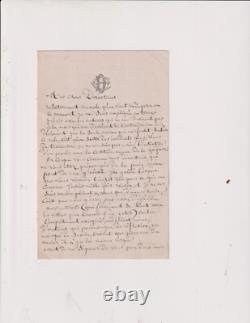
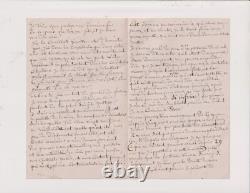


See the text about his disputes with Offenbach. The lines on the photos are due to the scanner. For articles with the same name, see Delannoy. Edmond Léopold Émile Delannoy, known as Delannoy, born in Arras and died on... He was a French actor and playwright.
The son of a lieutenant colonel of the Empire who later supported the Bourbons, and who, intending him for a military career, had secured him a full scholarship at the Prytanée in La Flèche. Delannoy waited for his mother’s death before defying his father’s reproaches and embarking on a theatrical career. Disowned by his elder brother, he presented himself to a provincial theater manager, who first sent him to Elbeuf. Then to La Rochelle, where he learned the trade by performing drama and comedy.
Arriving in Montmartre in 1840, under Edmond’s direction, he later went to Lille in 1843–44 as the leading comic actor, earning 250 francs a month, where he played opposite Déjazet. In 1845, he was in Antwerp, where on March 2 he recited a verse monologue of his own composition, Un soldat de l’Empereur. He was then seen in Amsterdam and Liège. Before accepting, in 1843, an engagement in Brussels, where he became, for a time, director of the Théâtre des Nouveautés.
After a tour in Amsterdam and Liège, he was engaged in 1848 at the Vaudeville by administrator Hugues Bouffé. He made his debut in the insignificant play Un coup de pinceau, before triumphing in a second original work, Le Serpent (Proudhon), then in La Foire aux Idées, a reactionary play by Clairville. Brother of the then Minister of Public Instruction. In La propriété c’est le vol, he created an Aristophanic role, a parody of a figure of realism, which aroused enthusiasm on one side and anger on the other.
As the cabal got involved, he was hissed with fury and applauded with frenzy. He made his debut at the Palais-Royal in L’Avare en gants jaunes, but soon returned to the Vaudeville, where he played a multitude of roles. A conscientious man, Delannoy took care of everything. He wanted to recover from the failure of his Roi Carotte, in 1872, with his comedy Don Quichotte at the Gaîté.
He begged to create this role, but when Offenbach had to relinquish control of the theater and the play could not be staged as a result, Delannoy, who had refused a renewed engagement at the Vaudeville in order to honor his six-month contract with Offenbach, was forced to wait until the success of the performances at the Théâtre de la Chaussée-d’Antin had run its course before finding work again. Left without pay, with the Gaîté even refusing to settle the six months owed under his contract, he was forced to make Offenbach pay him compensation through a lawsuit. His name remained long associated with the role of Péponnet in Théodore Barrière’s Les Faux Bonshommes. The tremendous success he had achieved in this role almost opened the doors of the Comédie-Française to him. Administrator Édouard Thierry entered into negotiations with him to replace Provost in financial roles, but having set terms that were too harsh, they were unable to reach an agreement.
By joining the Comédie-Française at that time, Delannoy would have made a financial sacrifice, since he was well paid at the Vaudeville, but he would have avoided the troubles he went through toward the end of his career. One day in 1875, he found himself ruined after a dishonest money changer vanished with his hard-earned savings. In 1882, after breaking with the Vaudeville, his career began to decline: he only made a brief stop at the Gymnase. From there, he moved to the Menus-Plaisirs, where drama was performed at the time, then to the Ambigu, where he triumphed in the role of Josserand in Pot-Bouille. This great success was to be the last of his career. When he took up his post at the Renaissance, where he wanted to establish vaudeville, Fernand Samuel engaged him, and he still played in 1886 and 1887, in addition to two or three new roles, Minard in the revival of Gavaut, Minard et Cie, and François in the revival of Le Choix d’un gendre, which had been one of his triumphs at the Vaudeville. Also a writer of merit, Delannoy left several poetic works full of wit and finesse. He also wrote several vaudevilles performed successfully in Brussels, and many highly applauded songs in Belgium in their time. Moreover, in 1884, while staying in Bagnères.Although he held political views strongly opposed to those of Félix Pyat, he had written, in collaboration with him, L’Homme de peine, a drama that was successful. Suffering for a long time from a stomach illness that forced him to eat very little, he could no longer, in his final days, take in any food, and remained in bed, getting up for a few moments each day. On the evening of his death, he went back to bed early and never woke up again. He had two children, a son and a daughter, the latter known on stage as “Mme Chandora.” “He was an actor of study, whose only fault was to give weight to every phrase of his role and to every word in the phrase.
] Delannoy had a heavy diction, and a manner of acting that was forceful and ponderous; but when the role was good, what strength he drew from that loyal diction and meticulous acting. ‘Three people move me: Delannoy, Tourgueneff.’ ‘Delannoy belonged to that strong race of actors of study who entered with conviction into the skin of the ordinary man they had to portray; in a word, who bent themselves to the demands of their creations.’ La propriété c’est le vol, socialist farce in 3 acts by Clairville. Role: Le Serpent, Paris, Théâtre du Vaudeville.
La Dame aux camélias, drama in 5 acts by Alexandre Dumas fils. Role: Duval père, Paris, Théâtre du Vaudeville. Les Parisiens, comedy in 3 acts by Théodore Barrière. Role: Martin, Paris, Théâtre du Vaudeville. Les Faux Bonshommes, comedy in 4 acts by Théodore Barrière. Role: Péponet, Paris, Théâtre du Vaudeville. Le Pantalon de Nessus, vaudeville in 1 act by Édouard Martin.Role: Beaufumé, Paris, Théâtre du Palais-Royal. La belle-mère a des écus, vaudeville in 3 acts by Alfred Delacour. Role: Routillac, Paris, Théâtre du Palais-Royal.
Les Métamorphoses d’un corset, vaudeville in 1 act by Édouard Brisebarre.