
- Homepage
- Author
- Alfred Bruneau (3)
- Anatole France (4)
- Auguste Maquet (4)
- Beydts (louis) (4)
- Camille Mauclair (3)
- Chateaubriand (5)
- Colette (4)
- Henri Barbusse (5)
- Jean-léon Gérôme (5)
- Julien DuprÉ (4)
- Louis Jouvet (4)
- Louise Read (6)
- Ludovic Halévy (4)
- Marcel Proust (5)
- Michel Chamillart (4)
- Paul Chabas (4)
- Paul Meurice (4)
- Roger Martin Du Gard (6)
- Sully Prudhomme (7)
- Violette Leduc (4)
- Other (4480)
- Era
- 18th Century (18)
- 1900 To 1960 (94)
- 1960s (6)
- 1970s (8)
- 19th (6)
- 19th Century (104)
- 20th Century (25)
- Beautiful Era (13)
- Belle Epoque (56)
- First Empire (10)
- Nineteenth (20)
- Nineteenth Century (13)
- Post-war (24)
- Restoration (17)
- Revolution (5)
- Roaring Twenties (30)
- Second Empire (24)
- Second World War (7)
- World War Ii (9)
- Xixth (4)
- Other (4076)
- Language
- Period
- 18th Century (14)
- 1900 To 1960 (163)
- 1960s (2)
- 19th (2)
- 19th Century (138)
- 20th Century (15)
- Belle Epoque (10)
- Belle Époque (3)
- First Empire (2)
- Nineteenth (24)
- Nineteenth Century (5)
- Post-war (5)
- Restoration (7)
- Revolution (3)
- Roaring Twenties (4)
- Second Empire (6)
- World War I (3)
- Xixth (6)
- Xixth Century (11)
- Other (4146)
- Subject
- Theme
CHATEAUBRIAND Signed Autograph Letter – Forgiveness, Gospel, Christianity
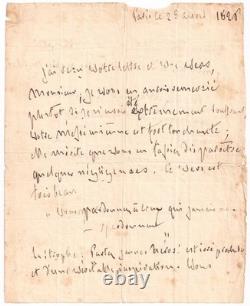
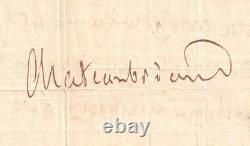
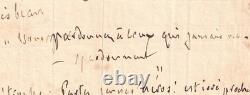


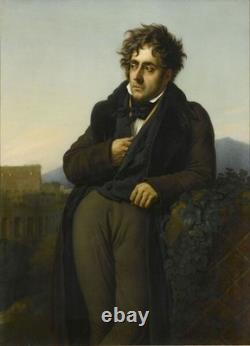


Chateaubriand advises a poet and praises the beauty of Christian forgiveness. “This line is very beautiful: You forgive those who never forgive.” Paris, April 25, 1826.
Foxing, a small area of paper loss, and typical splits along the folds at the margins. A magnetic acrylic display frame is included upon request. Dimensions: 30 × 21 cm.
A fine literary letter in which Chateaubriand highlights the power of the Gospel’s message: “This line is very beautiful: You forgive those who never forgive.” A foundational biblical message of unconditional forgiveness, reflecting Jesus’s teaching in the Gospels, this idea lies at the heart of Chateaubriand’s The Genius of Christianity (1802). In that work, he argues for the superiority of Christian morality over ancient moral systems, specifically because of the duty to offer forgiveness to those incapable of granting or feeling it.
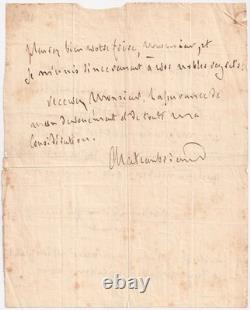
I have received your letter and your verses, sir, and would have thanked you sooner had I not been extremely unwell. Your Messénienne is very moving; it deserves to have a few lapses in its execution corrected. This line is very beautiful: “You forgive those who never forgive.” The stanza beginning “Go forth, young heroes!” is faultless and truly inspired.
At the time, Chateaubriand was suffering from gout and bouts of acute rheumatism affecting his joints. In 1818, Delavigne published his Messéniennes to lament the defeat at Waterloo and the occupation of France, reviving patriotic poetry during the Bourbon Restoration.
Below is the famous Romantic portrait of Chateaubriand by Anne-Louis Girodet (circa 1809).