
- Homepage
- Author
- Anatole France (4)
- Auguste Maquet (4)
- Benoît Fourneyron (3)
- Beydts (louis) (4)
- Charles Wagner (3)
- Chateaubriand (5)
- Colette (4)
- Henri Barbusse (5)
- Jean-léon Gérôme (5)
- Julien DuprÉ (4)
- Louis Jouvet (4)
- Louise Read (6)
- Ludovic Halévy (4)
- Marcel Proust (5)
- Michel Chamillart (4)
- Paul Chabas (4)
- Paul Meurice (4)
- Roger Martin Du Gard (6)
- Sully Prudhomme (7)
- Violette Leduc (4)
- Other (4440)
- Era
- 18th Century (18)
- 1900 To 1960 (94)
- 1930s (4)
- 1960s (5)
- 1970s (8)
- 19th (6)
- 19th Century (102)
- 20th Century (25)
- Beautiful Era (13)
- Belle Epoque (55)
- First Empire (10)
- Nineteenth (20)
- Nineteenth Century (13)
- Post-war (23)
- Restoration (17)
- Revolution (5)
- Roaring Twenties (30)
- Second Empire (24)
- Second World War (7)
- World War Ii (9)
- Other (4041)
- Language
- Period
- 18th Century (12)
- 1900 To 1960 (157)
- 1960s (2)
- 19th (2)
- 19th Century (136)
- 20th Century (15)
- Belle Epoque (10)
- Belle Époque (2)
- First Empire (2)
- Nineteenth (24)
- Nineteenth Century (5)
- Post-war (5)
- Restoration (7)
- Revolution (3)
- Roaring Twenties (4)
- Second Empire (6)
- World War I (3)
- Xixth (6)
- Xixth Century (11)
- Other (4117)
- Subject
- Theme
Alphonse DAUDET Letter and signed autograph ticket The Nabab Theatre
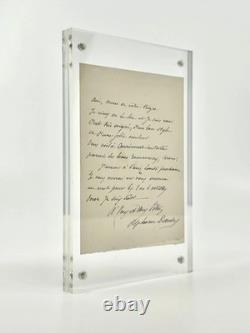
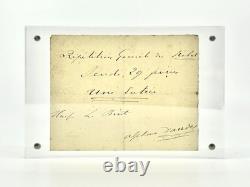
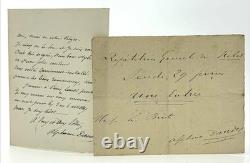
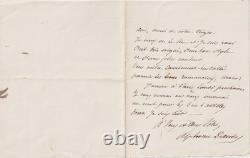
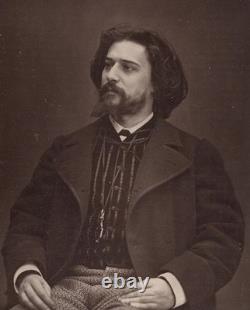

SLND, circa 1867, 1 page in 16. Small letter measuring 11 x 8.2 cm when folded / 11 x 17.5 cm when unfolded.
Presentation frame provided: 15 x 10 cm. A charming micro-letter accompanied by an amusing theater ticket. Lucien Biart embarked for Mexico at the age of eighteen, took care of zoology, and sent numerous collections of insects and birds to the Museum of Natural History in Paris. He was received as a professor of botany, chemistry, and physics by the Academy of Medicine of Puebla, was part of the Scientific Commission of Mexico, and was decorated with the Order of Our Lady of Guadalupe by Emperor Maximilian. Following the overthrow of the regime, his property was confiscated in 1867, and he returned to France.The Bizco mentioned by Alphonse Daudet in our letter is a novel belonging to travel literature inspired by Lucien Biart's Mexican experience. It was published in 1867 by Jules Verne's publisher, Pierre-Jules Hetzel.
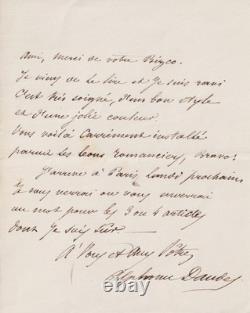
Our letter comes with a ticket handwritten by Alphonse Daudet (11.5 x 9 cm) [January 1880] addressed to the same Lucien Biart for the dress rehearsal of "Le Nabab," presented for the first time at the Vaudeville theater in Paris on January 30, 1880. Le Nabab is a novel by Alphonse Daudet published in 1877, depicting the morals of the social elite of the Second Empire and making a significant impact upon its release. The subsequent theatrical adaptation was also a success. Our ticket bears Daudet's handwritten note: "Dress rehearsal of Le Nabab. Friend, thank you for your Bizco. I just read it and I'm delighted. It's very well done, of good style and lovely color. You are truly established among the good novelists, congratulations! I will be in Paris next Monday. I will see you or send you a note for the 3 or 4 articles I am sure of. Friendship to you and yours." From its first performance, Émile Zola praised the success of the theatrical adaptation of Le Nabab."In theory, I do not like plays derived from novels; and I have given my reasons elsewhere. Only for the triumph of the ideas I support, I find that these plays provide me with excellent arguments. When a comedy like Le Nabab succeeds, does it not prove the close link between the movement that has taken place in the novel and that which is taking place in the theater? They are the same scenes, it is the same analysis carried from the book to the stage; and the public applauds, and it becomes passionate. There is our battle won.
Will it still be said that novelists are incapable of writing plays? Will it be deduced that what makes the success of a book cannot make that of a play?