
- Homepage
- Author
- Anatole France (4)
- Auguste Maquet (4)
- Benoît Fourneyron (3)
- Beydts (louis) (4)
- Charles Wagner (3)
- Chateaubriand (5)
- Colette (4)
- Henri Barbusse (5)
- Jean-léon Gérôme (5)
- Julien DuprÉ (4)
- Louis Jouvet (4)
- Louise Read (6)
- Ludovic Halévy (4)
- Marcel Proust (5)
- Michel Chamillart (4)
- Paul Chabas (4)
- Paul Meurice (4)
- Roger Martin Du Gard (6)
- Sully Prudhomme (7)
- Violette Leduc (4)
- Other (4439)
- Era
- 18th Century (18)
- 1900 To 1960 (94)
- 1930s (4)
- 1960s (5)
- 1970s (8)
- 19th (6)
- 19th Century (102)
- 20th Century (25)
- Beautiful Era (13)
- Belle Epoque (55)
- First Empire (10)
- Nineteenth (20)
- Nineteenth Century (13)
- Post-war (23)
- Restoration (17)
- Revolution (5)
- Roaring Twenties (30)
- Second Empire (24)
- Second World War (7)
- World War Ii (9)
- Other (4040)
- Language
- Period
- 18th Century (12)
- 1900 To 1960 (157)
- 1960s (2)
- 19th (2)
- 19th Century (136)
- 20th Century (15)
- Belle Epoque (10)
- Belle Époque (2)
- First Empire (2)
- Nineteenth (24)
- Nineteenth Century (5)
- Post-war (5)
- Restoration (7)
- Revolution (3)
- Roaring Twenties (4)
- Second Empire (6)
- World War I (3)
- Xixth (6)
- Xixth Century (11)
- Other (4116)
- Subject
- Theme
Alfred de Vigny: beautiful signed autograph letter, 1838
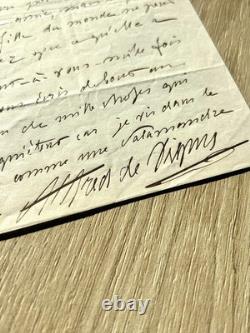
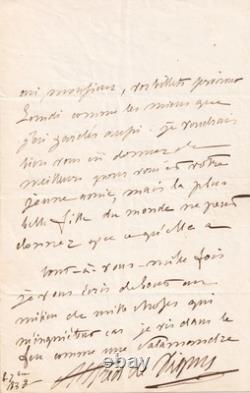
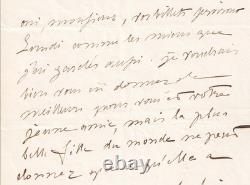
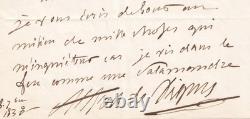

A beautiful letter with poetic imagery. “I write to you standing amid a thousand things that trouble me, for I live in the fire like a salamander.” One page in octavo on a double sheet. Size: 19.5 x 12.5 cm.
An exquisite letter in which, after recalling the famous proverb (later used by Alexandre Dumas in The Three Musketeers in 1844), “the most beautiful girl in the world can only give what she has,” Alfred de Vigny offers a dazzling poetic image of his inner turmoil: “I write to you standing amid a thousand things that trouble me, for I live in the fire like a salamander.
” This beautiful line from Vigny (“I live in the fire like a salamander”) is quoted by Emile Lauvrière in his 1909 biography, Alfred de Vigny; his life and work, Paris A.
The year 1838 was particularly emotionally charged for Alfred de Vigny, marked by the death of his mother on December 20, 1837, and his breakup with Marie Dorval a few weeks before this letter.
The play referred to is the premiere of Berlioz’s Benvenuto Cellini, which took place on Monday, September 10, 1838, at the Grand Opéra Le Peletier (destroyed by fire in 1873, which helped accelerate the construction of the Opéra Garnier in 1875).
“Yes, sir, your tickets will be useful on Monday, just like mine, which I have kept as well. I would gladly give you better ones for you and your young friend, but the most beautiful girl in the world can only give what she has. I write to you standing amid a thousand things that trouble me, for I live in the fire like a salamander.”
Jean-Baptiste Gindre, known as Gindre de Mancy, was a man of letters in Paris and a postal employee.
He was a friend of Anne François Tercy and Nodier. Secretary to Berryer, he also contributed to several newspapers.
Below: Alfred de Vigny, portrait by Pierre Daubigny, 1836. The Opéra Le Pelletier (Imperial Academy of Music), around 1821.