
- Homepage
- Author
- Anatole France (4)
- Auguste Maquet (4)
- Beydts (louis) (4)
- Chateaubriand (5)
- Colette (4)
- Ernest Daudet (3)
- Henri Barbusse (5)
- Jean-léon Gérôme (5)
- Julien DuprÉ (4)
- Louis Jouvet (4)
- Louise Read (6)
- Ludovic Halévy (4)
- Marcel Proust (5)
- Michel Chamillart (4)
- Paul Chabas (4)
- Paul Meurice (4)
- Proust (3)
- Roger Martin Du Gard (6)
- Sully Prudhomme (7)
- Violette Leduc (4)
- Other (4462)
- Era
- 18th Century (18)
- 1900 To 1960 (94)
- 1930s (4)
- 1960s (6)
- 1970s (8)
- 19th (6)
- 19th Century (103)
- 20th Century (25)
- Beautiful Era (13)
- Belle Epoque (56)
- First Empire (10)
- Nineteenth (20)
- Nineteenth Century (13)
- Post-war (23)
- Restoration (17)
- Revolution (5)
- Roaring Twenties (30)
- Second Empire (24)
- Second World War (7)
- World War Ii (9)
- Other (4060)
- Language
- Period
- 18th Century (12)
- 1900 To 1960 (161)
- 1960s (2)
- 19th (2)
- 19th Century (137)
- 20th Century (15)
- Belle Epoque (10)
- Belle Époque (3)
- First Empire (2)
- Nineteenth (24)
- Nineteenth Century (5)
- Post-war (5)
- Restoration (7)
- Revolution (3)
- Roaring Twenties (4)
- Second Empire (6)
- World War I (3)
- Xixth (6)
- Xixth Century (11)
- Other (4133)
- Region
- Theme
Alexandre DUMAS – Charming signed autograph letter, “Excursion Trains,” 1851
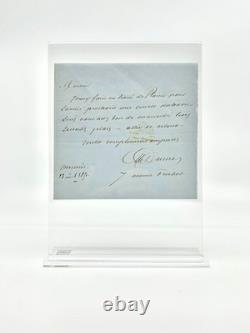
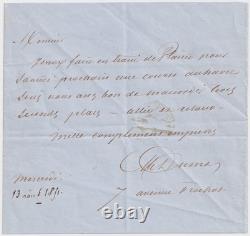
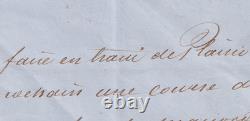


Alexandre Dumas takes one of the earliest excursion trains. A charming piece of French railway history featuring the author of The Three Musketeers.
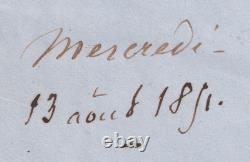
Paris, Wednesday, August 13, 1851. One page on a folded sheet, margins trimmed. Dimensions: 13.5 × 14 cm / With the included Plexiglas display frame: 21 × 15 cm.
A particularly charming piece of French railway history featuring the author of The Three Musketeers. Excursion trains were special services introduced for leisure, tourism, and the first popular Sunday outings.
Inspired by the early British railway excursions launched by Thomas Cook in 1841, the idea reached France in the mid-1840s. The Paris–Le Havre line taken by Dumas was not merely one of the first: it introduced the concept to France in 1847. The journey took around six hours—one-third of the time required by mail coach—making a two-day round trip possible for the first time. Return tickets were sold at half price, prompting the popular press slogan “the seaside for five francs.
”
Dumas was watching his spending at this point in his life. Ruined by the bankruptcy of his Théâtre-Historique and the liquidation of his Château de Monte-Cristo, he was pursued by more than a hundred creditors and faced the imminent threat of imprisonment for debt.
Excursion trains became hugely popular during the Second Empire, with services quickly expanding to Dieppe, Trouville, Deauville, and the Forest of Fontainebleau, laying the foundations for seaside holidays to become accessible to a wider public.
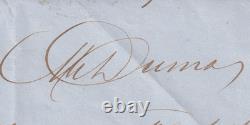
A very fine, bold signature.
I would like to make a trip to Le Havre on an excursion train next Saturday. Would you be so kind as to grant me three second-class return tickets?
From April 1850 to December 1851, Alexandre Dumas lived there in an elegant detached house set behind a garden enclosed by railings. Avenue Frochot, now closed to the public but well known to residents of Pigalle and Rue Victor-Massé, was home to many artists and prominent figures, including Django Reinhardt, Victor Massé, Sylvie Vartan, Gustave Moreau, Jean Renoir, and Paul Meurice, who hosted Victor Hugo there upon his return from exile in 1870.
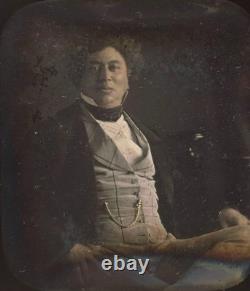
Below: the very first photograph of Alexandre Dumas, a daguerreotype taken in 1851, the same year as this letter.
Below: a French steam locomotive, 1855.