
- Homepage
- Author
- Anatole France (4)
- Auguste Maquet (4)
- Benoît Fourneyron (3)
- Beydts (louis) (4)
- Charles Wagner (3)
- Chateaubriand (5)
- Colette (4)
- Henri Barbusse (5)
- Jean-léon Gérôme (5)
- Julien DuprÉ (4)
- Louis Jouvet (4)
- Louise Read (6)
- Ludovic Halévy (4)
- Marcel Proust (5)
- Michel Chamillart (4)
- Paul Chabas (4)
- Paul Meurice (4)
- Roger Martin Du Gard (6)
- Sully Prudhomme (7)
- Violette Leduc (4)
- Other (4439)
- Era
- 18th Century (18)
- 1900 To 1960 (94)
- 1930s (4)
- 1960s (5)
- 1970s (8)
- 19th (6)
- 19th Century (102)
- 20th Century (25)
- Beautiful Era (13)
- Belle Epoque (55)
- First Empire (10)
- Nineteenth (20)
- Nineteenth Century (13)
- Post-war (23)
- Restoration (17)
- Revolution (5)
- Roaring Twenties (30)
- Second Empire (24)
- Second World War (7)
- World War Ii (9)
- Other (4040)
- Language
- Period
- 18th Century (12)
- 1900 To 1960 (157)
- 1960s (2)
- 19th (2)
- 19th Century (136)
- 20th Century (15)
- Belle Epoque (10)
- Belle Époque (2)
- First Empire (2)
- Nineteenth (24)
- Nineteenth Century (5)
- Post-war (5)
- Restoration (7)
- Revolution (3)
- Roaring Twenties (4)
- Second Empire (6)
- World War I (3)
- Xixth (6)
- Xixth Century (11)
- Other (4116)
- Subject
- Theme
Marin LA MOTTE PIQUET signed autograph letter
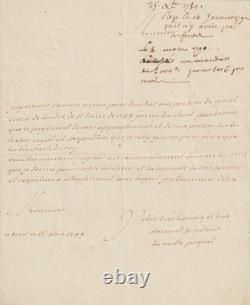

Autograph letter signed, Brest, December 25, 1789, addressed to “Monsieur.” Very rare entirely autograph letter from the great sailor at the end of his life. In need, he cannot rely solely on the “king’s bounty.”
I once again turn to you to receive my pension as Grand Cross of the Order of Saint Louis for 1789. I need it all the more because the payment of my lodgings and my pension from the royal treasury has been suspended, and I have little to live on besides the king’s bounty.
Please, sir, accept, together with my New Year’s wishes, the hopes I form for your happiness and the assurance of the very sincere and respectful attachment with which I have the honor to be, your very humble and very obedient servant. At Brest, this 25th of December 1789.
Two replies appear at the head of the letter: “Reply 1790 that there were no funds,” and then “On March 4, 1790, sent a warrant for 2,000 livres for the six previous months.”
La Motte-Picquet took part in all the great naval military campaigns under the reigns of Louis XV and Louis XVI. Under the latter monarch, the American War of Independence allowed him to distinguish himself under the orders of Vice-Admiral d’Estaing.
Even the English admired his tactical talent, and he was praised by his enemies. Admiral Hyde Parker thus assured him: “Our enmity is temporary and depends on our masters, but your merit has engraved in my heart the greatest admiration for you.”
Louis XVI, who was very interested in the Navy, was aware of La Motte-Picquet’s exploits and courage: he named him Commander of the Order of Saint Louis in 1780, then Grand Cross in 1784.
La Motte-Picquet would breathe his last a year and a half later, becoming one of the great figures in naval history.
Certificate of authenticity available on request.