
- Homepage
- Author
- Anatole France (4)
- Auguste Maquet (4)
- Benoît Fourneyron (3)
- Beydts (louis) (4)
- Charles Wagner (3)
- Chateaubriand (5)
- Colette (4)
- Henri Barbusse (5)
- Jean-léon Gérôme (5)
- Julien DuprÉ (4)
- Louis Jouvet (4)
- Louise Read (6)
- Ludovic Halévy (4)
- Marcel Proust (5)
- Michel Chamillart (4)
- Paul Chabas (4)
- Paul Meurice (4)
- Roger Martin Du Gard (6)
- Sully Prudhomme (7)
- Violette Leduc (4)
- Other (4439)
- Era
- 18th Century (18)
- 1900 To 1960 (94)
- 1930s (4)
- 1960s (5)
- 1970s (8)
- 19th (6)
- 19th Century (102)
- 20th Century (25)
- Beautiful Era (13)
- Belle Epoque (55)
- First Empire (10)
- Nineteenth (20)
- Nineteenth Century (13)
- Post-war (23)
- Restoration (17)
- Revolution (5)
- Roaring Twenties (30)
- Second Empire (24)
- Second World War (7)
- World War Ii (9)
- Other (4040)
- Language
- Period
- 18th Century (12)
- 1900 To 1960 (157)
- 1960s (2)
- 19th (2)
- 19th Century (136)
- 20th Century (15)
- Belle Epoque (10)
- Belle Époque (2)
- First Empire (2)
- Nineteenth (24)
- Nineteenth Century (5)
- Post-war (5)
- Restoration (7)
- Revolution (3)
- Roaring Twenties (4)
- Second Empire (6)
- World War I (3)
- Xixth (6)
- Xixth Century (11)
- Other (4116)
- Subject
- Theme
Marcel Proust / Signed autograph letter / Uncle Weil / Childhood / In Search of Lost Time
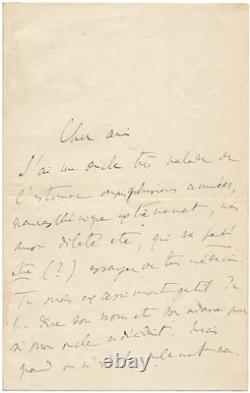
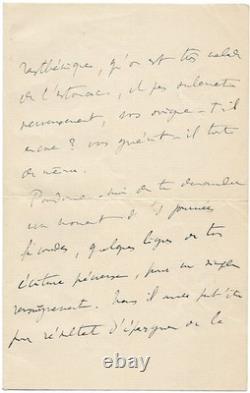
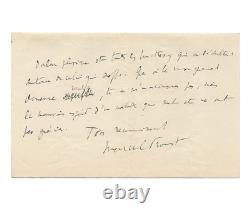
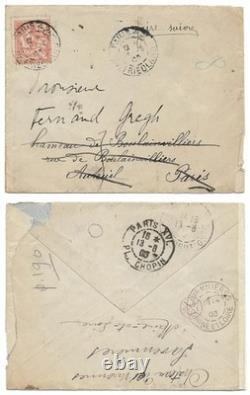

Autograph letter signed “Marcel Proust” to Fernand Gregh, S. [Paris, August 13, 1903], 3 pp. Small octavo, written in black ink. Old tab mark on the fourth page, correction over one word.
Watermark: “Au Printemps Paris - Nouveau Papier Français.” Attached: autograph envelope, stamped and postmarked.
Uncle Weil, a figure from Proust’s happy childhood, was soon to be treated by Dr. Dubois, the model for Du Boulbon in In Search of Lost Time.
“Dear friend, I have an uncle who has been very ill with a stomach ailment for several years, extremely neurasthenic.
You would be extremely kind to tell me his name and address in case my uncle decides to go. But when someone is not only neurasthenic, but very ill with the stomach, and not only nervous, does he still treat him? Does he cure him all the same? Forgive me for asking you to spare a moment of your fruitful days, a few lines of your precious handwriting, for a simple piece of information.
But it may perhaps have the result of sparing physical pain and all the sadness that follows around the one who suffers. Even if the information remains useless, you will not blame me for it, but rather the bad spirit of a sick man who wants to be cured and cannot be.”
Denis-Georges Weil, Proust’s maternal uncle, maintained a very friendly relationship with the future writer. He held long literary conversations with him, sometimes to the point of forgetting the time to go to court, where he worked as a magistrate. Uncle Weil perfectly illustrates the family unity Proust knew in childhood, marked by close shared living and a love of conversation.
He was also co-owner, with Madame Proust, of the building on Boulevard Haussmann where Proust would live from 1906 onward. The real transposed into the work. Paul Dubois, a famous professor of neuropathology at the time, ran a clinic in Bern and published several works, including The Influence of the Mind on the Body (1901).
Fernand Gregh had been treated by him in 1900, and Proust, who was thinking of consulting him in 1905, recommended him to his uncle Denis-Georges Weil. Proust, who cites Dubois’s theories in the notes to his translation of Ruskin’s Sesame and Lilies, would also transpose the anecdote of his uncle’s visit to the doctor in The Guermantes Way: Dubois told Weil that he was not ill, and Weil immediately felt better, just as happens to the Narrator’s grandmother with Dr.
Finally, Proust also makes his character die of the uremia that carried off his uncle.He quickly became the editor of this periodical, while Proust published there among his first important literary and theoretical texts. Along with two other students from the lycée and members of Le Banquet, Louis de La Salle and Daniel Halévy, Proust and Gregh began writing a novel together in 1893. This collective text, conceived on the model of La Croix de Berny (written by Gautier and three other writers), was never completed, but Proust was its main contributor and already introduced themes that would later reappear in In Search of Lost Time.
Fernand Gregh then devoted himself almost exclusively to poetry, winning a prize from the Académie française in 1896.
His friendship with Proust, however, had its ups and downs, notably because of aesthetic differences. Moreover, like many “established” writers, Gregh initially looked down on Proust somewhat, while Proust in turn mocked the ridiculousness of his friend’s “charming” character. Fernand Gregh entered the Académie française in 1953 and left behind important literary memories there, including a volume titled My Friendship with Marcel Proust (1958), in which he published the letters he had received from the author of In Search of Lost Time. 203 (in a text truncated by three words and with two variants, established from Fernand Gregh’s book).
Marcel Proust I - Biography [New edition], ed.