
- Homepage
- Author
- Achille Fould (3)
- Auguste Maquet (4)
- Benoît Fourneyron (3)
- Beydts (louis) (4)
- Charles Monselet (3)
- Chateaubriand (5)
- Colette (4)
- Henri Barbusse (5)
- Jean-léon Gérôme (5)
- Julien DuprÉ (4)
- Louis Jouvet (4)
- Louise Read (6)
- Ludovic Halévy (4)
- Marcel Proust (5)
- Michel Chamillart (4)
- Paul Chabas (4)
- Paul Meurice (4)
- Roger Martin Du Gard (6)
- Sully Prudhomme (7)
- Violette Leduc (4)
- Other (4421)
- Era
- 18th Century (18)
- 1900 To 1960 (94)
- 1960s (5)
- 1970s (8)
- 19th (6)
- 19th Century (101)
- 20th Century (25)
- Beautiful Era (13)
- Belle Epoque (55)
- First Empire (10)
- First World War (4)
- Nineteenth (20)
- Nineteenth Century (13)
- Post-war (23)
- Restoration (17)
- Revolution (5)
- Roaring Twenties (30)
- Second Empire (24)
- Second World War (7)
- World War Ii (9)
- Other (4022)
- Language
- Period
- 18th Century (12)
- 1900 To 1960 (157)
- 1960s (2)
- 19th (2)
- 19th Century (131)
- 20th Century (15)
- Belle Epoque (10)
- Belle Époque (2)
- First Empire (2)
- Nineteenth (24)
- Nineteenth Century (5)
- Post-war (5)
- Restoration (7)
- Revolution (3)
- Roaring Twenties (4)
- Second Empire (5)
- World War I (3)
- Xixth (6)
- Xixth Century (11)
- Other (4103)
- Subject
- Type
Erik Satie: Beautiful autograph letter signed, full of irony (1905)
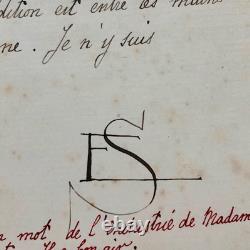
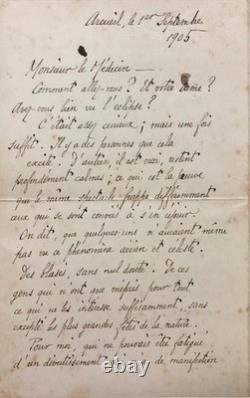
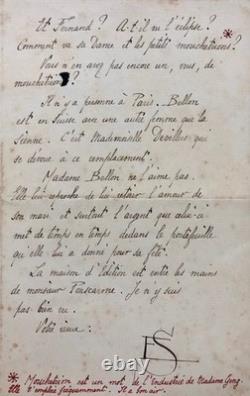

Erik SATIE (1866–1925) – Composer and pianist. Handwritten signed letter addressed to his friend Dr. Satie, inspired witness of a solar eclipse.
Did you see the eclipse properly? It was rather curious; but once is enough.
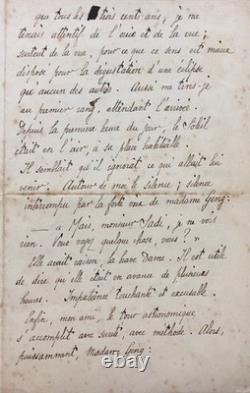
As for me, who could not be tired of an entertainment that only appears once every three hundred years, I kept myself attentive in both hearing and sight; especially sight, since that sense is better suited than any other to savoring an eclipse. So I took my place in the front row, waiting for its arrival. From the first hour of the day, the Sun was in the sky, in its usual place. It seemed unaware of what was about to happen to it. Around me, silence; silence interrupted by Madame Geng’s loud voice:
“But, Monsieur Sadi, I see nothing.
”
She was right, the brave lady. It should be said that she was several hours early. A touching and excusable impatience.
At last, my friend, the astronomical turn of events took place safely, methodically. Then, in a powerful voice, Madame Geng said:
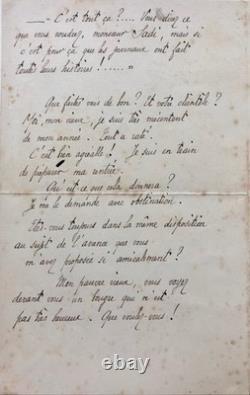
“Is that all? You can say what you like, Monsieur Sadi, but if that’s what all the newspapers made such a fuss about! What are you doing that’s good?
She blames her for taking away her husband’s love and, above all, the money he now and then puts into the wallet she gave him for her name day. The publishing house is in the hands of Monsieur Ponscarne. I am not looked upon very favorably there. Mouchetrion is a word from Madame Geng’s repertoire. It has a good ring to it.
The stars were indeed not very favorable to the composer: Satie was to write incidental music for a play by Jean Kolb and Maurice de Féraudy. Following an argument during rehearsal, the play was ultimately performed without music! In October 1905, Erik Satie enrolled in the counterpoint class of Vincent d’Indy, where Albert Roussel and Auguste Sérieyx were his teachers. He was weary, he said, of “being reproached for an ignorance he believed he had, since competent people pointed it out in his works.” Claude Debussy nevertheless tried to dissuade him: “Be careful, you are playing a dangerous game.
At your age, one does not change one’s skin anymore.” Satie would be a diligent and studious pupil; during this period, he composed two piano pieces.
Madame Geng and her husband owned a café-restaurant in Arcueil, at the corner of Rue Benoît-Malon. For 10 years, Satie was a regular there, and over time he was treated more as a friend than as a customer. Tired of this favor and possibly offended, he suddenly stopped going there and began frequenting another café, located opposite the church.
Collected and presented by Ornella Volta, CXV, page 118.