
- Homepage
- Author
- Achille Fould (3)
- Anatole France (4)
- Auguste Maquet (4)
- Beydts (louis) (4)
- Chateaubriand (5)
- Colette (4)
- Henri Barbusse (5)
- Jean-léon Gérôme (5)
- Julien DuprÉ (4)
- Louis Jouvet (4)
- Louise Read (6)
- Ludovic Halévy (4)
- Marcel Proust (5)
- Michel Chamillart (4)
- Paul Chabas (4)
- Paul Meurice (4)
- Proust (3)
- Roger Martin Du Gard (6)
- Sully Prudhomme (7)
- Violette Leduc (4)
- Other (4442)
- Era
- 18th Century (18)
- 1900 To 1960 (94)
- 1930s (4)
- 1960s (5)
- 1970s (8)
- 19th (6)
- 19th Century (102)
- 20th Century (25)
- Beautiful Era (13)
- Belle Epoque (55)
- First Empire (10)
- Nineteenth (20)
- Nineteenth Century (13)
- Post-war (23)
- Restoration (17)
- Revolution (5)
- Roaring Twenties (30)
- Second Empire (24)
- Second World War (7)
- World War Ii (9)
- Other (4043)
- Language
- Period
- 18th Century (12)
- 1900 To 1960 (159)
- 1960s (2)
- 19th (2)
- 19th Century (136)
- 20th Century (15)
- Belle Epoque (10)
- Belle Époque (2)
- First Empire (2)
- Nineteenth (24)
- Nineteenth Century (5)
- Post-war (5)
- Restoration (7)
- Revolution (3)
- Roaring Twenties (4)
- Second Empire (6)
- World War I (3)
- Xixth (6)
- Xixth Century (11)
- Other (4117)
- Subject
- Theme
EMMANUEL CHABRIER COMPOSER Signed Manuscript Letter 1888
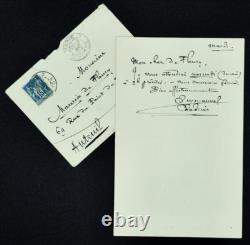
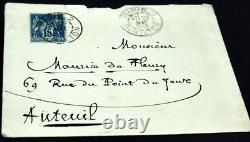
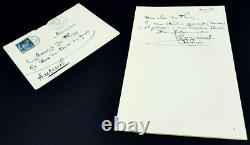
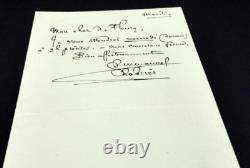
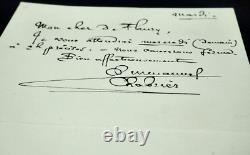
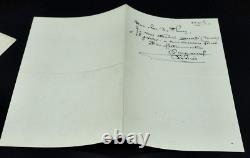
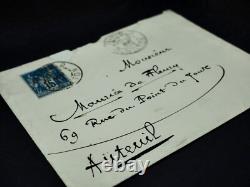
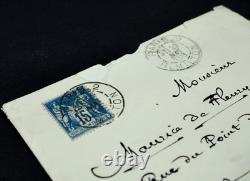

Autographed letter signed and handwritten envelope from Emmanuel Chabrier to Maurice de Fleury - Circa 1888? His unique style, a blend of Spanish influences and modernity, has inspired many musicians. A close friend of Chabrier, De Fleury was a respected figure in the Parisian medical community and had an interest in the arts. Written probably in 1888, this letter illustrates a friendly and conspiratorial relationship between Chabrier and De Fleury. Chabrier sets a meeting with his "dear friend.
" Format: Letter 1 page front. Condition: Generally good, paper slightly yellowed, writing perfectly legible. A student of Charcot, De Fleury began his career as an intern at the Sainte-Périne Hospital. At the Salpêtrière, he directed the laboratory of physiological psychology, affirming himself as a central figure in Parisian psychiatry.
Close to literary circles, Maurice de Fleury maintained close relationships with Émile Zola and Joris-Karl Huysmans. A fervent admirer of the Rougon-Macquart, he provided Zola with his scientific knowledge on heredity, a crucial theme in Zola's work. His publications on the transmission of nervous diseases, violence, and alcoholism profoundly influenced Zola's work, notably Doctor Pascal. Ten years after their collaboration, De Fleury painted a medico-psychological portrait of Zola: "From ten to noon, Zola writes still - less easily and less well than during the initial hour - and that's it for the whole day, he will be good only for writing letters.
This is the power of the most powerful brain in the literary field at the end of the century. With this very modest little routine, three hours a day in two sessions, this man whose attention is modest...Finds a way to give us, every ten months, one of those books where nothing is missing from the solidity of the structure... Nor anything that constitutes the creative force, genius, to say the word.
" He also maintains a sustained correspondence with friends and a famous clientele from the artistic, literary, and political circles of the time: Alphonse Daudet, Alexandre Dumas (son), Sarah Bernhardt, la Bartet, Madame Simone, Sacha Guitry, Edouard Herriot, Raymond Poincaré, Jean Rostand, Victorien Sardou, Robert De Flers, Rejane. Very "in vogue" among "intellectuals" (in the words of Victor Segalen), the young doctor also figures in the list of symbolist authors - alongside Paul Adam, Henri de Régnier, and Gustave Kahn - in an essay by André Barre in 1911. Recognized for his literary as well as scientific talents, he published significant works on depressive states and neurasthenia. Elected free associate of the Academy of Medicine in 1909, he was elevated to the rank of commander of the Legion of Honor in 1923.He is famous for his numerous supporting roles in cinema, notably in films such as "Le Viager" and "Les Gaspards.