
- Homepage
- Author
- Alfred Bruneau (3)
- Anatole France (4)
- Auguste Maquet (4)
- Benoît Fourneyron (3)
- Beydts (louis) (4)
- Chateaubriand (5)
- Colette (4)
- Henri Barbusse (5)
- Jean-léon Gérôme (5)
- Julien DuprÉ (4)
- Louis Jouvet (4)
- Louise Read (6)
- Ludovic Halévy (4)
- Marcel Proust (5)
- Michel Chamillart (4)
- Paul Chabas (4)
- Paul Meurice (4)
- Roger Martin Du Gard (6)
- Sully Prudhomme (7)
- Violette Leduc (4)
- Other (4434)
- Era
- 18th Century (18)
- 1900 To 1960 (94)
- 1930s (4)
- 1960s (5)
- 1970s (8)
- 19th (6)
- 19th Century (102)
- 20th Century (25)
- Beautiful Era (13)
- Belle Epoque (55)
- First Empire (10)
- Nineteenth (20)
- Nineteenth Century (13)
- Post-war (23)
- Restoration (17)
- Revolution (5)
- Roaring Twenties (30)
- Second Empire (24)
- Second World War (7)
- World War Ii (9)
- Other (4035)
- Language
- Period
- 18th Century (12)
- 1900 To 1960 (157)
- 1960s (2)
- 19th (2)
- 19th Century (134)
- 20th Century (15)
- Belle Epoque (10)
- Belle Époque (2)
- First Empire (2)
- Nineteenth (24)
- Nineteenth Century (5)
- Post-war (5)
- Restoration (7)
- Revolution (3)
- Roaring Twenties (4)
- Second Empire (6)
- World War I (3)
- Xixth (6)
- Xixth Century (11)
- Other (4113)
- Subject
- Theme
Anna de Noailles Signed Autograph Letter to Countess Greffulhe, 1917
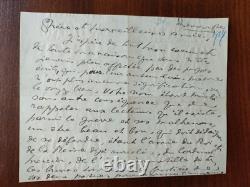
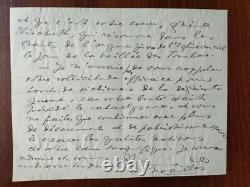
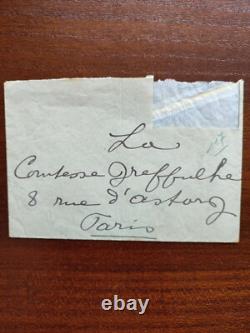

A vivid signed autograph letter, written during the First World War (December 1917), to the fascinating Countess Greffulhe, who fears that an article mentioning her name may cause her harm.
Dear and wonderful friend,
I hope with all my heart and all my reason that you are not affected by written remarks which, for their author himself, no longer have any meaning; you can see that your name is mentioned there with no other purpose than to remind readers that there exists, amid war and its sorrows, a beautiful and good soul who must disdain to defend herself, being the friend of the King and the Queen, already glorified, like Cardinal Mercier, and of the immortal souls of all the men who fell at the frontier of our two homelands to repel the enemy; and that it is your heart, dear Élisabeth, which resounds in the chants of the organ that rises from the church to heaven on the day of the Vigil of the Tombs.
I am not trying to remind you of your effective care for so many victims of this heartbreaking war, because your goodness had already preceded the catastrophe, and you have only continued, with even greater devotion and patriotism, to exercise the natural qualities of your magnificent heart.
Anna de Noailles
Anna de Noailles is probably referring to one of the accusatory articles written by Léon Daudet in December 1917 against Paul Painlevé and his “muse,” Countess Greffulhe. The article in question may be the one published on the 8th in L’Action Française, titled The Affairs of Treason and the High Court. Léon Daudet mentions the Paix-Séailles affair, named after Sergeant Charles Paix-Séailles. This troubling figure, who died by suicide in 1921, was arrested in November 1917 for having passed sensitive documents concerning the Army of the Orient to Miguel Almereyda, director of the anarchist newspaper Le Bonnet Rouge.
According to Léon Daudet, Countess Greffulhe and Paul Painlevé, newly appointed President of the Council in September, had tried to obstruct his journalistic investigation. One can understand Countess Greffulhe’s fear of seeing her name linked to an “agent of treason,” two months after the execution of Mata Hari, and Anna de Noailles’s eagerness to reassure her about the “devotion” and “patriotism” known to all. He was the author, in 1915, of the resistance letter Patriotism and Endurance, in which he called on the Belgians to fight against the German invader.
A religious, patriotic, and charitable gathering founded by Countess Greffulhe in 1916 in memory of the Belgian soldiers fallen on the field of honor.