
- Homepage
- Author
- Anatole France (4)
- Auguste Maquet (4)
- Benoît Fourneyron (3)
- Beydts (louis) (4)
- Charles Wagner (3)
- Chateaubriand (5)
- Colette (4)
- Henri Barbusse (5)
- Jean-léon Gérôme (5)
- Julien DuprÉ (4)
- Louis Jouvet (4)
- Louise Read (6)
- Ludovic Halévy (4)
- Marcel Proust (5)
- Michel Chamillart (4)
- Paul Chabas (4)
- Paul Meurice (4)
- Roger Martin Du Gard (6)
- Sully Prudhomme (7)
- Violette Leduc (4)
- Other (4439)
- Era
- 18th Century (18)
- 1900 To 1960 (94)
- 1930s (4)
- 1960s (5)
- 1970s (8)
- 19th (6)
- 19th Century (102)
- 20th Century (25)
- Beautiful Era (13)
- Belle Epoque (55)
- First Empire (10)
- Nineteenth (20)
- Nineteenth Century (13)
- Post-war (23)
- Restoration (17)
- Revolution (5)
- Roaring Twenties (30)
- Second Empire (24)
- Second World War (7)
- World War Ii (9)
- Other (4040)
- Language
- Period
- 18th Century (12)
- 1900 To 1960 (157)
- 1960s (2)
- 19th (2)
- 19th Century (136)
- 20th Century (15)
- Belle Epoque (10)
- Belle Époque (2)
- First Empire (2)
- Nineteenth (24)
- Nineteenth Century (5)
- Post-war (5)
- Restoration (7)
- Revolution (3)
- Roaring Twenties (4)
- Second Empire (6)
- World War I (3)
- Xixth (6)
- Xixth Century (11)
- Other (4116)
- Subject
- Theme
Alexandre Dumas writes to Victor Hugo, autograph letter signed, 1836

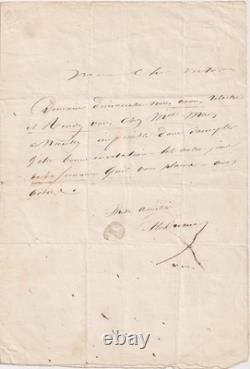
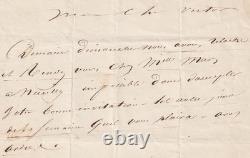
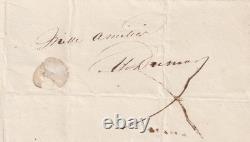
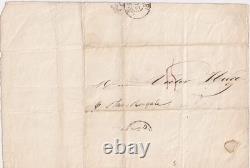
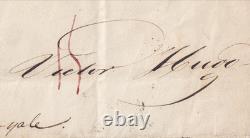

Paris, May 20, 1836 - A quarto page on a bifolium with an autograph address. Splendid calligraphy by Alexandre Dumas, writing Victor Hugo’s name in the address. Large size: 23 x 31 cm when the leaves are unfolded (single page: 23 x 16 cm).
In May 1836, Dumas achieved undeniable popular success at the Théâtre de la Porte-Saint-Martin with Don Juan de Marana, which premiered on April 30. His main goal at the time was to return to the Comédie-Française (Théâtre-Français). The meeting at the actress’s luxurious villa in Neuilly was part of the courtship Dumas paid to the actress in hopes that she would accept his future projects.
Dumas wanted to impress and to compete on Victor Hugo’s own terrain, Hugo then being the master of romantic verse. The play was finally staged on December 26, 1837, at the Théâtre-Français. Dumas spent fortunes on sets and costumes to recreate imperial Rome. Despite the presence of Mademoiselle Mars, the play was received coolly and remained on the bill for only about twenty performances. It was a commercial and critical failure for Dumas, but also the dawn of greater fame and of his greatest successes to come with the rise of his future serialized novels.
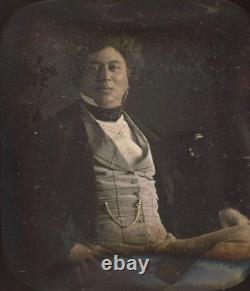
That same year, 1836, Alexandre Dumas and Victor Hugo, both 34 years old, maintained close relations within the framework of their theatrical projects and worked together to obtain from the Duke of Orléans the privilege of creating a theater devoted to the Romantic repertoire (which would eventually become the Théâtre de la Renaissance). In November 1836, Dumas even wrote to Hugo to inform him of his efforts with M. Guizot regarding this theater project: “We must therefore do nothing one without the other, but everything one through the other and one with the other.” Autograph letters between the two men are particularly sought after. Tomorrow, Sunday, we have no performance and an appointment at M.(Mademoiselle) Mars’s house in Neuilly, so it is impossible to accept your kind invitation. Any other day during the week that you like - at your service. [On the left leaf, in Alexandre Dumas’s hand]. Below, the first photograph of Alexandre Dumas, 1851, daguerreotype.
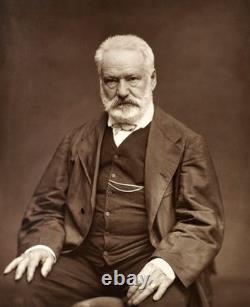
Below, Victor Hugo by Étienne Carjat in 1876. Below, Mademoiselle Mars, porcelain portrait after Gérard’s painting by Aimée Perlet, 1823.